
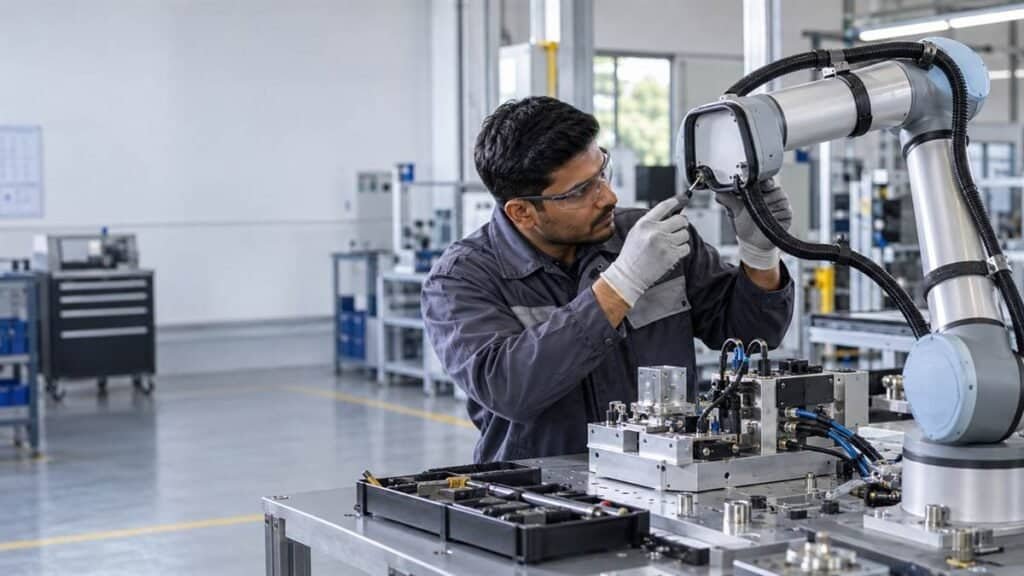
Silicone Extrusions help collaborative robots and automation systems with flexible sealing, cushioning, grip, and protection.
They support precision movement by protecting sensitive parts from vibration, dust, contact stress, and temperature variation.
Collaborative robots are designed to work closer to people, products, and precision equipment. Unlike heavy industrial machines that operate behind fixed barriers, cobots often handle delicate parts, move through compact spaces, and repeat fine movements throughout the day. In such systems, even a small rubber profile can influence safety, accuracy, and equipment life.
This is where Silicone Extrusions become useful. They provide soft but durable support in areas where robotic systems need sealing, edge protection, cushioning, insulation, or controlled contact. Their flexibility makes them suitable for moving assemblies, compact enclosures, sensor areas, and automation equipment that cannot depend only on rigid components.
Built for the Contact Points
In collaborative robotics, the point of contact matters. A gripper may need a soft sealing edge. A panel may need a flexible gasket. A sensor housing may need protection from dust or vibration. A moving arm may require cable protection or an edge profile that does not crack under repeated motion.
Silicone Extrusions can support these contact points without adding unnecessary stiffness. They can compress, recover, and maintain their shape through repeated use. This makes them suitable for automation systems where movement and consistency are equally important.
Supporting Precision Without Disturbing Movement
Precision automation depends on smooth motion. If a seal is too hard, it may create resistance. If a protective profile is too weak, it may wear out quickly. If a gasket does not fit properly, dust or moisture can enter sensitive areas.
Silicone rubber offers a useful balance. It remains flexible, resists aging, and can handle temperature variation better than many general-purpose rubber materials. When manufactured as an extrusion, it can be shaped to match the exact surface, groove, channel, or enclosure requirement.
This helps automation designers protect equipment without affecting the movement or fitment of the system.
Useful Around Sensors, Cables, and Enclosures
Modern robotic systems depend on sensors, wires, control modules, cameras, and compact electronic assemblies. These parts need protection from dust, vibration, movement, and contact stress. Silicone Extrusions can help seal and protect these areas while allowing the equipment to remain accessible for maintenance.
For example, a silicone gasket around a sensor enclosure can help reduce contamination. A cable protection profile can prevent rubbing or sharp-edge damage. A small edge trim can protect both the equipment and nearby operators from exposed surfaces.
In collaborative environments, these details support both equipment protection and safer interaction.
Where Silicone Extrusions Can Be Used
Silicone Extrusions can be developed for several cobot and automation applications, including:
- Gripper edge profiles and soft contact strips
- Sensor enclosure gaskets and protective seals
- Cable routing channels and insulation profiles
- Panel seals for compact automation equipment
- Edge trims for robotic arms, guards, and fixtures
- Vibration cushioning profiles for precision assemblies
Each application has its own requirement. Some need softness. Some need heat resistance. Others need clean sealing, dimensional accuracy, or repeated compression performance.
Custom Profiles for Compact Automation Designs
Collaborative robots and precision automation systems are often built with limited space. Standard rubber profiles may not always fit the design. A profile may need to be thin, hollow, dense, soft, transparent, coloured, or shaped for a specific groove.
Silicone Extrusions can be manufactured in different forms such as cords, strips, D-profiles, P-profiles, U-channels, hollow sections, and custom shapes. The final profile can be developed based on size, hardness, flexibility, colour, and performance requirement.
This customization helps the rubber part become part of the design rather than an afterthought added during installation.
Long-Term Value in Repetitive Motion Systems
Automation equipment works in cycles. Doors open and close. Arms move repeatedly. Grippers press, release, and return. Panels vibrate. Cables shift slightly during operation. Over time, these repeated actions can damage low-quality materials.
Silicone Extrusions support longer service life because they can handle compression, flexing, and environmental exposure with consistent performance. Their resistance to aging and temperature variation also makes them useful in production areas where equipment must run for long hours.
For manufacturers, this can help reduce replacement needs and improve reliability in precision automation systems.
Conclusion
Silicone Extrusions are a dependable solution for collaborative robots and precision automation systems. They support sealing, cushioning, edge protection, cable safety, sensor protection, and reliable movement in equipment that needs both flexibility and accuracy.
At Shree Rubber Works, we manufacture customized Silicone Extrusions for robotics, automation, industrial equipment, and precision manufacturing applications. Our profiles can be developed as per required shape, size, hardness, colour, flexibility, and performance needs to support reliable use in modern automation systems. Contact us today to discuss your custom silicone extrusion requirements.