
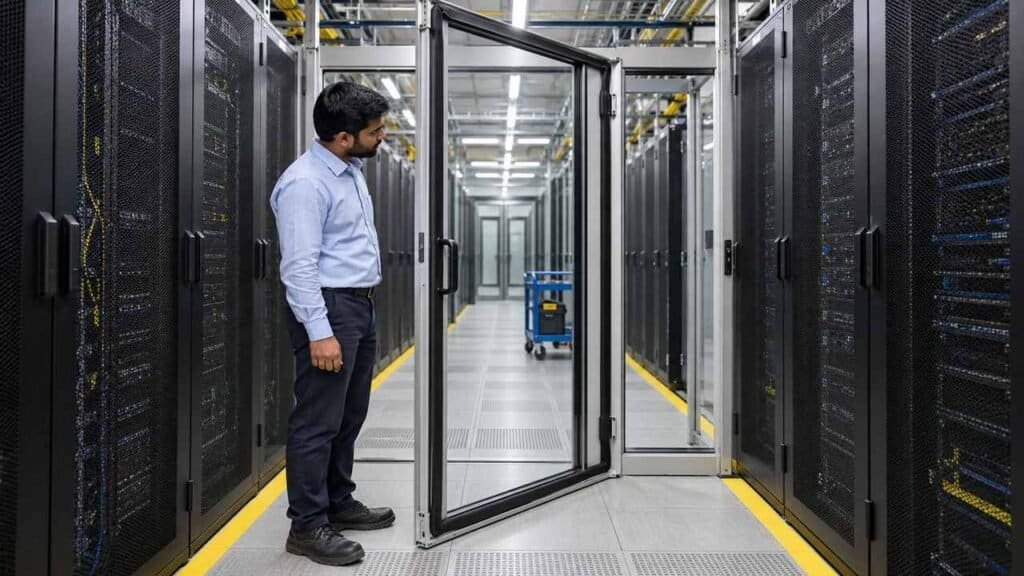
AI data centers place unusually high demands on cooling infrastructure. Dense server racks, GPU clusters, high airflow volumes, and continuous operation leave little room for air leakage or uncontrolled recirculation. Even a small gap around a containment panel, rack door, cable opening, or cooling interface can allow conditioned air and hot exhaust air to mix.
EPDM sealing profiles help close those gaps. Used in the right locations, they support controlled airflow paths, improve containment performance, and help cooling systems deliver air where it is needed most.
How do EPDM extrusions support thermal management in AI data centers?
EPDM extrusions support thermal management by sealing gaps around rack doors, containment panels, cable entries, cooling-unit interfaces, and equipment enclosures. By reducing uncontrolled air leakage, they help preserve the separation between cold supply air and hot server exhaust air. This can support more stable equipment inlet conditions, reduce bypass airflow, and make cooling capacity easier to manage.
For facilities using hot-aisle or cold-aisle containment, sealing is not a minor finishing detail. It is part of the airflow-management strategy. A containment system may have strong panels, doors, and ceiling sections, but its effectiveness can fall if gaps are left around edges, joints, or service penetrations.
For applications that require custom shapes, dimensions, and compounds, explore custom EPDM rubber extrusions designed for industrial sealing requirements.
Why airflow sealing matters in AI data centers
Most rack-based data centers are arranged so that servers draw cooler air through the front of the rack and reject warmer air at the rear. In a well-managed setup, the cold air is delivered to equipment inlets while hot exhaust air is returned to the cooling system without mixing back into the supply path.
The problem begins when air takes the easiest route instead of the intended route.
For example, a gap between two containment panels may allow cold air to escape into a hot aisle. A poorly sealed cable opening can create another leakage path. Gaps around rack doors or blanking panels can also allow hot exhaust air to return to server inlets. The result can be inconsistent inlet temperatures, local hot spots, higher fan demand, or unnecessary cooling effort.
AI data centers make this challenge more important because high-density computing creates concentrated heat loads. Airflow has to be directed carefully, especially where air-cooled racks operate alongside liquid-cooled equipment, rear-door heat exchangers, or thermally segmented zones.
Where EPDM sealing profiles are used
EPDM sealing profiles can be designed for many airflow-control points within a data center environment.
| Application Area | Purpose of the Sealing Profile | Airflow-Management Benefit |
|---|---|---|
| Rack doors and side panels | Seals perimeter gaps | Helps limit bypass and recirculation paths |
| Hot- or cold-aisle containment | Seals joints between doors, roofs, panels, and frames | Supports separation of hot and cold air streams |
| Cable-entry openings | Seals around cable cut-outs and service penetrations | Reduces unintended leakage through floor, ceiling, or panel openings |
| Cooling-unit interfaces | Seals panel edges and equipment connections | Helps maintain intended supply and return airflow paths |
| Modular enclosure systems | Seals removable panels, access doors, and expansion joints | Supports a consistent enclosure environment during expansion or maintenance |
The profile does not need to be complicated to be useful. A well-designed bulb seal, U-channel, edge trim, sponge profile, or co-extruded section can solve a specific leakage issue when it matches the gap size, compression range, mounting method, and maintenance requirement.
EPDM extrusions for containment panels and rack enclosures
Data center containment systems often include multiple interfaces: panel-to-panel joints, door perimeters, ceiling sections, support frames, rack ends, and service access points. These interfaces need seals that can tolerate repeated opening and closing, minor dimensional variation, and long-term compression.
EPDM is commonly selected for sealing applications because it offers good resistance to weathering, ozone, and many environmental conditions. However, the final material choice should not be made on the polymer name alone. The compound, hardness, profile geometry, mounting method, and operating environment all need to match the application.
For example, a removable containment door may require a soft bulb profile that seals with light compression. A rigid panel edge may need a U-channel profile with an integrated sealing lip. A cable-management enclosure may require an edge trim that protects the panel while reducing air leakage around the opening.
The key is to design the profile around the interface, rather than trying to force a standard section into every location.
A practical airflow example
Consider a high-density AI rack row inside a cold-aisle containment system. The cooling system delivers conditioned air into the contained aisle, where servers pull it through the front of their racks. If gaps remain around containment doors, roof panels, or cable openings, part of that conditioned air can escape before it reaches the equipment inlets.
The cooling system may then compensate by increasing airflow or lowering supply-air temperature. That can add pressure to the cooling system without solving the actual leakage issue.
Installing correctly specified EPDM sealing profiles at those interfaces helps the containment system do its intended job: keep supply air in the cold aisle and keep hot exhaust air out. The goal is not simply to add more sealing material. The goal is to create a controlled airflow path that supports the cooling design.
For a broader discussion of sealing and airflow protection in these facilities, see EPDM extrusions for airflow management in AI data centers.
Selecting an EPDM sealing profile for a data center application
Before selecting or designing a profile, engineering and facility teams should review the actual installation conditions.
1. Identify the leakage path
Start with the location of the gap. Is it between containment panels, around a door, under a rack, through a cable opening, or at a cooling-equipment interface?
A sealing profile should solve a known airflow path. Installing a general-purpose gasket without understanding the gap can lead to poor compression, difficult assembly, or little improvement in airflow control.
2. Measure the gap and compression range
The profile must accommodate the real gap, including manufacturing tolerances and movement during installation. A seal that is too small may not close the gap. A seal that is too large may create excessive compression, make doors difficult to close, or wear prematurely.
For doors and removable panels, the compression range should also account for repeated maintenance access.
3. Choose the right profile geometry
Common options include:
- Bulb seals for door and panel perimeters
- U-channel profiles for panel edges
- Sponge profiles for uneven or variable gaps
- Solid profiles where greater structural support is needed
- Co-extruded profiles where one section grips the substrate and another provides the sealing function
The right geometry depends on the surface, gap shape, mounting method, and required service life.
4. Consider the operating environment
Although data centers are controlled facilities, sealing components may still be exposed to elevated return-air temperatures, cleaning processes, dust, humidity changes, vibration, and frequent service activity. In some applications, fire-performance requirements or compatibility with adjacent materials may also influence the final compound selection.
For air-cooled IT equipment, the recommended inlet-temperature range is often discussed in relation to ASHRAE guidance. However, the equipment manufacturer’s own environmental requirements should always be checked before setting operating conditions or selecting associated sealing components.
5. Plan for installation and maintenance
A profile that performs well on paper can still fail if it is hard to install or difficult to replace. Consider whether the seal will be bonded, mechanically retained, pushed onto an edge, or installed in a channel. Also consider whether technicians need to remove adjacent panels regularly.
A custom profile should make installation easier, not create an additional maintenance problem.
Benefits beyond airflow control
A well-designed EPDM extrusion can contribute to more than airflow management.
- It can help reduce dust entry through gaps around enclosures and panels.
- It can improve the fit and finish of containment structures.
- It can reduce vibration or rattling at panel interfaces.
- It can protect sharp panel edges where an edge-trim profile is used.
- It can support repeatable sealing performance across modular or expandable data-center designs.
These benefits are especially useful in AI data centers, where facility layouts may change as computing capacity, rack density, and cooling methods evolve.
Frequently asked questions
Why are EPDM extrusions used in AI data centers?
EPDM extrusions are used to seal gaps around containment systems, rack enclosures, panels, doors, and cable entries. Their role is to support controlled airflow, reduce unintended air leakage, and help maintain the separation between cold supply air and hot exhaust air.
Can EPDM sealing profiles be customized for server racks and containment systems?
Yes. EPDM profiles can be customized by shape, size, hardness, density, and mounting arrangement. This allows the profile to match a specific panel edge, door frame, rack enclosure, cable opening, or containment-system joint.
Where should airflow leaks be checked in a data center?
Common locations include gaps between racks, rack doors, containment panels, roof sections, floor or ceiling cable openings, blanking-panel areas, and cooling-unit interfaces. The best starting point is to identify where conditioned air is escaping or where hot air may be returning to equipment inlets.
Is one standard sealing profile suitable for every data center application?
Usually not. Different areas may need different profile geometries and compression properties. A door perimeter, a fixed panel joint, and a cable-entry opening each have different requirements. Selecting a profile based on the actual gap and installation method leads to a more reliable result.
Choosing the right profile for a cooling-critical environment
In AI data centers, airflow management is closely connected to cooling performance, equipment reliability, and the ability to support higher rack densities. EPDM sealing profiles are a practical part of that system when they are designed around real leakage paths, actual gap dimensions, and the facility’s containment approach.
For a custom solution, provide the panel or enclosure drawing, gap dimensions, substrate material, preferred mounting method, operating environment, and any relevant performance requirements. That information helps determine the right extrusion profile for the application.
To discuss custom industrial rubber solutions for your data-center sealing requirement, contact Shree Rubber Works.