
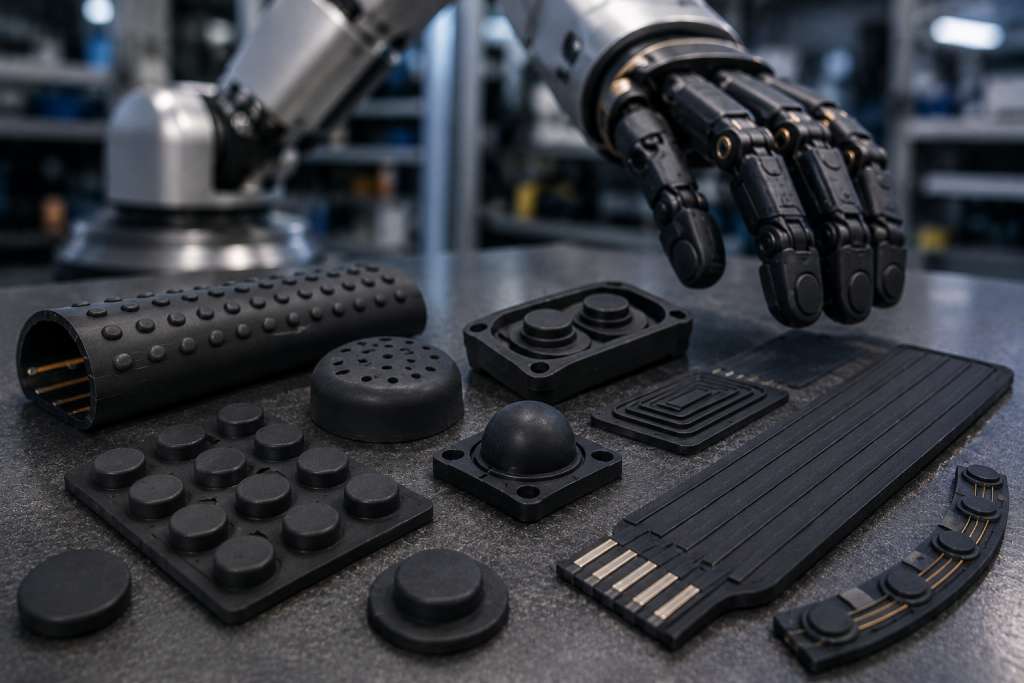
Smart conductive rubber helps robotic systems detect touch, pressure, and contact more naturally. It supports tactile feedback and sensor integration in grippers, control surfaces, end effectors, and safety-sensitive robotic applications.
Robots are becoming better at seeing, moving, and calculating. The next challenge is helping them sense what is happening at the point of contact.
A robotic arm picking up a glass component, a warehouse gripper handling packaging, or a collaborative robot working beside people cannot rely on force alone. It must understand whether it is touching an object, how much pressure it is applying, and whether that contact has changed.
This is where smart conductive rubber becomes relevant. It combines the flexibility and cushioning of rubber with the ability to carry or respond to electrical signals. The material can be used as a functional interface between mechanical movement and sensor-based feedback.
Turning Contact into Useful Data
In conventional robotic systems, rubber is often used for grip, cushioning, sealing, or protection. Conductive rubber adds another dimension. When pressure, strain, or contact changes, the material can show a measurable electrical response.
That response can be linked to sensor systems, allowing the robot to identify changes in touch or movement. Instead of treating every object in the same way, the system can receive feedback that helps it adapt its grip or action.
For example, a robotic gripper handling a delicate product may need to recognize when contact has been made before applying additional force. A conductive rubber layer can support this type of tactile sensing while also providing a softer, more controlled contact surface.
A More Natural Layer for Robotic Interaction
Many robotic applications require a surface that can flex, compress, and recover repeatedly. Hard sensing components may work in some systems, but they are not always ideal for curved surfaces, moving joints, gripping areas, or applications where shock absorption is also important.
Smart conductive rubber offers a useful balance. It can be molded or fabricated into shapes that follow the design of the robot while supporting contact sensing. This makes it suitable for situations where a component needs to do more than one job.
It can cushion a surface. It can improve grip. It can respond to pressure. It can support sensor integration.
That combination makes conductive rubber especially useful in robotics where physical interaction is becoming more complex.
Where Tactile Feedback Makes a Difference
Tactile feedback is important whenever a robot needs to understand how it is interacting with an object or surface. It can support better control in tasks that involve picking, sorting, pressing, assembling, handling, or guiding.
Smart conductive rubber solutions may be used in:
- Robotic grippers and end effectors
- Pressure-sensitive contact pads
- Collaborative robot safety surfaces
- Touch-responsive control interfaces
- Automated assembly systems
- Material handling and packaging robots
- Medical and laboratory robotics
- Wearable robotic or assistive equipment
Supporting Safer Human-Robot Collaboration
As collaborative robots become more common, interaction safety becomes more important. Machines working near people need to respond more carefully to accidental contact, pressure changes, or unexpected movement.
Conductive rubber can support sensor-enabled surfaces that help identify contact conditions. In certain applications, this may improve the robot’s ability to react, slow down, stop, or adjust movement when the surface senses a change.
The material is also soft and flexible, which can be useful when hard edges or rigid sensing surfaces are not suitable.
Custom Design Is Central to Performance
There is no standard conductive rubber component that works for every robotic system. A gripper pad may require high flexibility and pressure sensitivity. A safety strip may need fast response across a larger contact area. A sensor-integrated molded part may need a particular shape, hardness, conductivity level, and surface finish.
Smart conductive rubber can be developed in different forms, including molded pads, strips, contact points, covers, gripper inserts, seals, and custom-shaped components. The material can be tailored according to the mechanical and electrical requirements of the application.
This makes it easier for robotics manufacturers to integrate sensing capability without compromising the physical performance of the rubber component.
Beyond Protection: A Smarter Functional Role
The value of conductive rubber in robotics lies in its ability to support both physical and digital functions. It can protect sensitive surfaces, absorb impact, improve grip, and contribute to sensor feedback at the same time.
As robotics moves toward more adaptive and responsive systems, materials that can bridge mechanical movement and real-time sensing will become increasingly important. Smart conductive rubber offers one practical route for creating that connection.
Conclusion
Smart conductive rubber solutions support tactile feedback and sensor integration in robotics by helping systems detect contact, pressure, movement, and surface interaction. Their flexibility, cushioning ability, and conductive properties make them useful for robotic grippers, collaborative systems, sensing surfaces, and custom automation components.
At Shree Rubber Works, we manufacture customized rubber mouldings products for robotics, industrial automation, and sensor-based applications. Our components can be developed as per required shape, hardness, conductivity, flexibility, and performance needs to support reliable tactile feedback and advanced robotic functionality. Contact us today to discuss your custom conductive rubber requirements.