
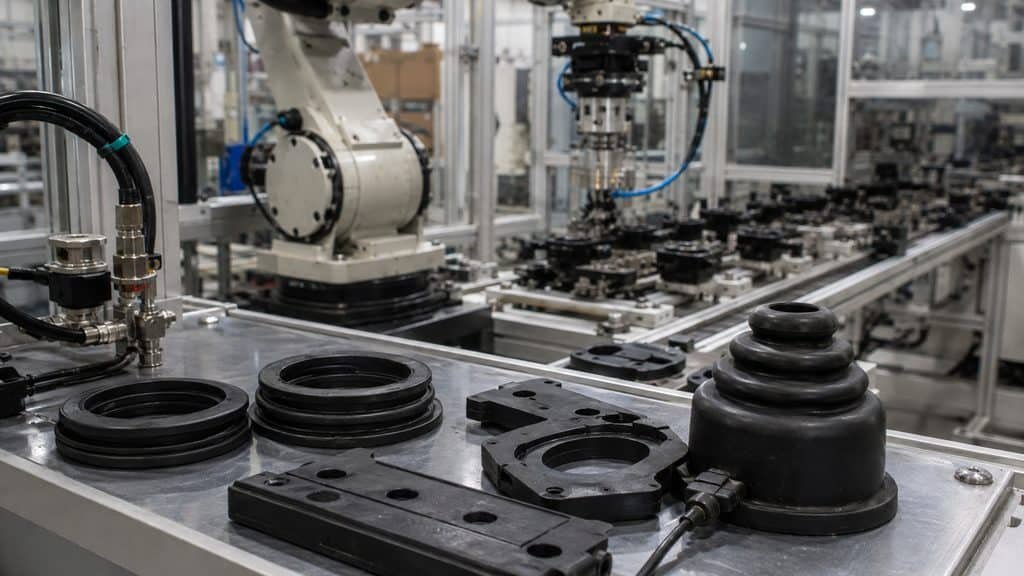
Smart Conductive Rubber helps smart factories detect pressure, movement, strain, vibration, and contact changes in equipment.
It supports predictive maintenance by adding sensing capability to selected rubber components used in automated systems.
Smart factories are built around connected equipment, real-time data, and faster maintenance decisions. Machines are no longer expected to only perform their assigned function. They are also expected to provide useful signals about their condition, workload, stress points, and possible failure risks. This shift has increased the importance of materials that can support both physical performance and digital monitoring.
Smart Conductive Rubber is one such material. It combines the flexibility, cushioning, and protective qualities of rubber with conductive properties that can support signal response. Instead of acting only as a passive seal, pad, gasket, or contact surface, conductive rubber can become part of a monitoring system that helps identify changes in pressure, compression, strain, or movement.
A Smarter Role for Rubber in Industrial Equipment
Rubber components are commonly used in manufacturing equipment because they absorb vibration, reduce impact, seal gaps, improve grip, and protect surfaces. In a traditional setup, these parts perform mechanically but do not provide information about what they are experiencing during operation.
Smart Conductive Rubber adds a functional layer to this role. When the material is compressed, stretched, or deformed, its electrical behaviour can change. This change can be connected to a sensing or monitoring system, allowing the equipment to capture useful feedback from the point of contact.
This makes conductive rubber valuable in equipment areas where physical interaction matters. It can help monitor pressure on a surface, detect repeated compression, identify contact changes, or support vibration-related observation without removing the natural flexibility of rubber.
Why Predictive Maintenance Needs Contact-Level Insight
Predictive maintenance depends on identifying early signs of failure before equipment breaks down. Many systems already monitor temperature, vibration, speed, current, pressure, and load. However, some issues begin at the contact surface, where machine parts press, grip, seal, move, or absorb impact.
Conductive rubber components can support this level of monitoring. A conductive pad may help indicate changes in pressure. A conductive gasket may support contact detection in an enclosure. A molded conductive component may help track stress in a moving assembly. These signals can help maintenance teams understand whether a part is operating normally or moving toward failure.
In smart factories, this type of information can reduce guesswork. Instead of waiting for visible wear, leakage, vibration increase, or equipment stoppage, teams can use sensor-supported feedback to plan maintenance more effectively.
Useful Across Automated Manufacturing Systems
Smart Conductive Rubber can be used in different areas of automated equipment where movement, contact, or pressure needs to be understood. In robotic systems, it may support gripper pads or contact surfaces. In conveyors, it may help monitor pressure or vibration-prone areas. In enclosures, it may support conductive sealing or contact detection. In machine mounts, it may help observe changes in load or stress.
The advantage is that the component can continue to perform as rubber while also supporting data collection. It can cushion, protect, seal, or grip, while providing a measurable response based on mechanical changes. This dual function makes it suitable for Industry 4.0 environments where every component has the potential to contribute to smarter operations.
Custom Design for Smart Factory Applications
Smart Conductive Rubber is not a one-size-fits-all solution. Each application has its own mechanical and electrical requirement. A pressure-sensitive pad may need a different hardness and conductivity level compared to a conductive gasket or vibration-monitoring interface. A robotic contact surface may require flexibility, wear resistance, and a specific response under repeated compression.
The component can be customized based on shape, size, hardness, conductivity, flexibility, surface finish, and operating environment. It may be developed as a molded part, gasket, strip, pad, contact surface, seal, or custom profile depending on the equipment design.
This customization is important because the component must perform reliably as both a rubber part and a sensing-enabled material. If the mechanical design is not correct, the part may not fit or last properly. If the conductive response is not matched to the application, the monitoring output may not be useful.
Supporting Safer and More Reliable Operations
In smart factories, downtime can affect production schedules, output quality, and maintenance costs. Small equipment issues can become larger failures if they are not detected early. Smart Conductive Rubber components can help create an additional layer of awareness in areas where direct contact, load, or movement is important.
These components can support safer human-machine interaction, better monitoring of automated systems, and more informed maintenance decisions. They are especially useful in applications where flexible contact surfaces are needed but conventional sensors may be difficult to integrate.
By combining rubber performance with conductive functionality, Smart Conductive Rubber helps bridge the gap between mechanical protection and real-time equipment intelligence.
FAQ
What is Smart Conductive Rubber?
Smart Conductive Rubber is a rubber material designed with conductive properties that allow it to carry or respond to electrical signals. It can be used in components that need both rubber flexibility and sensing-related functionality.
How does Smart Conductive Rubber support predictive maintenance?
It can help detect changes in pressure, strain, movement, compression, or contact. These changes can provide useful signals for monitoring equipment condition and identifying early signs of stress or wear.
Where can conductive rubber components be used in smart factories?
They can be used in robotic grippers, pressure-sensitive pads, machine mounts, conductive gaskets, vibration-monitoring interfaces, safety surfaces, automated handling systems, and custom equipment components.
Is Smart Conductive Rubber a replacement for regular sensors?
It is not always a direct replacement. In many applications, it works as a sensing-enabled material that can support or complement monitoring systems, especially where a flexible rubber contact surface is needed.
Can Smart Conductive Rubber be customized?
Yes. Smart Conductive Rubber components can be customized based on shape, hardness, conductivity, flexibility, thickness, surface finish, and application requirements.
Conclusion
Smart Conductive Rubber components are a valuable solution for smart factories and predictive maintenance applications. They help detect pressure, strain, movement, vibration, and contact changes while still providing the flexibility, cushioning, sealing, and protection expected from rubber components.
At Shree Rubber Works, we manufacture customized Smart Conductive Rubber components for industrial automation, smart factories, sensor integration, and predictive maintenance applications. Our components can be developed as per required shape, hardness, conductivity, flexibility, and performance needs to support reliable equipment monitoring and long-term industrial performance. Contact us today to discuss your custom conductive rubber requirements.