
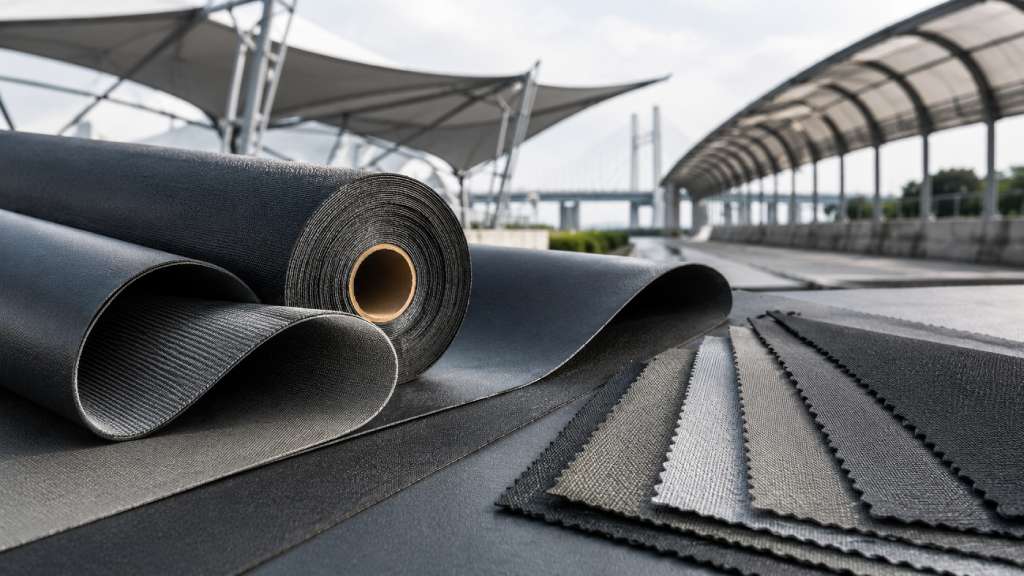
Rubber-coated fabrics provide flexible, reinforced protection for architectural and infrastructure projects. They are ideal for applications that need weather resistance, abrasion protection, movement support, and long service life.
In architecture and infrastructure, materials are expected to perform for years while facing outdoor exposure, mechanical stress, and changing environmental conditions. Covers, membranes, barriers, joints, protective layers, and enclosure systems often need to remain flexible without losing strength.
This is where rubber-coated fabrics become valuable. They combine the structural strength of fabric with the protective performance of rubber. The result is a material that can bend, cover, seal, protect, and withstand demanding use without failing too early.
The Role of Rubber-Coated Fabrics in Modern Projects
Modern infrastructure is not only built with concrete, steel, and glass. Many systems also depend on flexible materials that protect, separate, seal, or absorb movement. These materials may not always be visible, but they play an important role in long-term performance.
Rubber-coated fabrics are used where ordinary fabric may not be strong enough and plain rubber may not offer enough reinforcement. The fabric layer gives the material tear strength and dimensional stability, while the rubber coating protects it from moisture, abrasion, weather, and surface damage.
Why Long-Life Applications Need Reinforced Protection
Architectural and infrastructure projects are often exposed to harsh conditions. Sunlight, rain, wind, humidity, pollution, temperature changes, and repeated movement can slowly weaken materials over time. If the selected material is not suitable, cracks, tears, leakage, or surface wear can appear much earlier than expected.
Rubber-coated fabrics help reduce these risks by offering a combination of flexibility and protection. They can perform in applications where the material needs to move without tearing and protect without becoming rigid. This makes them suitable for both fixed and flexible infrastructure requirements.
Performance Benefits That Matter
The strength of rubber-coated fabrics comes from how they respond to real project conditions. They are designed to support durability, movement, and protection in one material.
- Strong resistance to weather exposure and moisture
- Better tear strength due to fabric reinforcement
- Good abrasion resistance for demanding environments
- Flexibility for moving or foldable applications
- Customizable rubber coating, thickness, and finish
- Longer service life compared to ordinary flexible materials
These benefits make rubber-coated fabrics useful for applications where frequent replacement is difficult, costly, or disruptive.
Useful Across Architecture and Infrastructure
Rubber-coated fabrics can be adapted for a wide range of project needs. In architectural applications, they may be used as protective covers, flexible membranes, enclosure materials, or weather-resistant layers. In infrastructure, they can support expansion zones, barriers, industrial curtains, transport systems, and equipment protection.
Their value lies in their ability to handle both exposure and movement. A bridge or tunnel application may need durability against abrasion and weather. An architectural membrane may need flexibility and visual consistency. An industrial enclosure may need protection from dust, water, or outdoor conditions.
Designed Around the Application
No two projects have the exact same material requirement. A rubber-coated fabric used for an outdoor cover will not have the same specification as one used for an expansion joint or infrastructure barrier.
The final material can be customized based on base fabric type, rubber compound, coating thickness, surface finish, flexibility requirement, tear and abrasion resistance, and exposure conditions. This customization helps ensure that the material is matched to the actual working environment instead of using a generic solution.
Reducing Maintenance Over Time
One of the biggest advantages of using rubber-coated fabrics is long-term reliability. Infrastructure and architectural projects often involve high replacement costs, especially when the material is installed in difficult-to-access areas.
By choosing a reinforced and weather-resistant material, project owners can reduce premature wear, improve protection, and extend service life. This supports better maintenance planning and helps avoid frequent repairs caused by material failure.
Conclusion
Rubber-coated fabrics are a practical material choice for architectural and infrastructure applications that need flexibility, strength, weather resistance, and long-term durability. Their fabric-reinforced structure and rubber-coated surface make them suitable for demanding environments where ordinary materials may not last.
At Shree Rubber Works, we manufacture customized rubber products for industrial, architectural, and infrastructure applications. Our materials can be developed as per required fabric type, rubber compound, coating thickness, finish, and performance needs to support long-life use in demanding project environments. Contact us today to discuss your rubber-coated fabric requirements.