
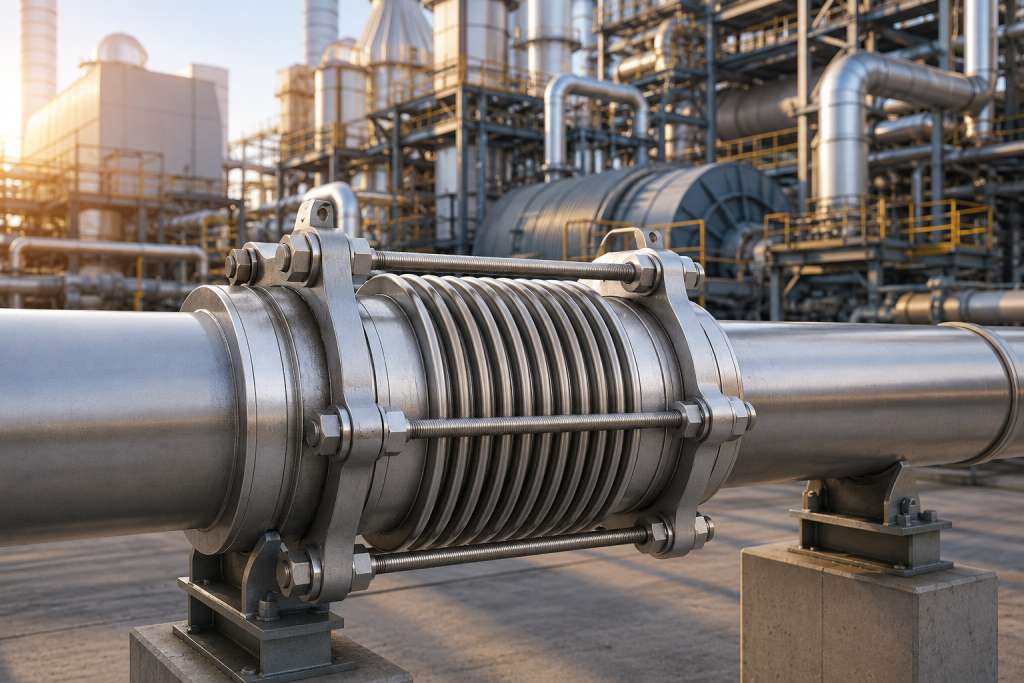
Expansion joints help power generation facilities absorb thermal movement, vibration, and pipe misalignment without placing excess stress on connected equipment. Selecting the right expansion joint supports safer operation, lower maintenance needs, and longer pipeline life.
Power generation facilities operate through cycles of heat, pressure, flow, and vibration. Steam lines, flue gas ducts, cooling water systems, boiler connections, turbines, pumps, and auxiliary piping are all exposed to temperature changes during start-up, shutdown, and continuous operation. As temperatures rise, metal pipes and ducts expand. When they cool, they contract again.
This movement may appear small, but across long pipeline runs and high-temperature systems, it can create significant stress. If the movement is not controlled, it can affect flanges, valves, pumps, supports, ducts, and connected equipment. That is why expansion joints are an important part of thermal movement control in power generation facilities.
An expansion joint is designed to create flexibility within a piping or ducting system. It absorbs controlled movement so that the load is not transferred directly to nearby equipment. Depending on the system, the joint may accommodate axial movement, lateral movement, angular movement, vibration, or minor misalignment.
Thermal Movement Is a System Issue
In a power plant, thermal expansion does not happen in isolation. A hot steam line expands along its length. A flue gas duct can shift as operating temperature changes. Cooling water systems may experience vibration from pumps and pressure variation from flow changes. When these movements are restricted, the resulting force can travel through the system.
This can lead to leakage, distorted flanges, damaged supports, increased vibration, and early wear in mechanical equipment. In more serious situations, it can affect the reliability of critical plant sections. Expansion joints help reduce this stress by allowing the system to move within a controlled range.
The purpose is not simply to add a flexible component into the line. The purpose is to protect the complete system from the effects of thermal expansion and operational movement.
The Type of Movement Shapes the Selection
Expansion joint selection begins with understanding how the system is expected to move. Some applications mainly require axial movement absorption, where the pipe expands and contracts along its own length. Other systems may need lateral movement capability because of structural shifts, offset piping, or changes in support conditions. In ducting systems, angular movement may also need to be considered.
The operating medium is equally important. Steam, hot air, flue gas, cooling water, treated water, chemicals, and other fluids place different demands on the joint material and design. A component selected for a cooling water line may not be suitable for a high-temperature flue gas duct. Similarly, an expansion joint that performs well in a low-pressure system may not meet the demands of a higher-pressure steam or process line.
Selecting the right joint therefore requires a clear understanding of temperature range, pressure conditions, movement direction, pipe size, installation layout, and fluid compatibility.
Why Material Choice Matters
The material used in an expansion joint has a direct effect on its performance and service life. In power generation facilities, the joint may be exposed to heat, pressure, vibration, moisture, chemicals, or external weather conditions. It must be able to maintain flexibility while resisting the specific stresses of the application.
Rubber expansion joints are often used in water, cooling, pumping, and vibration-isolation applications because they can absorb movement and reduce noise transmission. Metallic expansion joints may be selected for higher-temperature or high-pressure applications where metal bellows are required. Fabric expansion joints are commonly used in flue gas ducting and air-handling systems where larger movement and high-temperature gases are involved.
The right selection depends on the actual operating environment rather than a standard product specification.
Installation Conditions Cannot Be Ignored
Even a correctly selected expansion joint can underperform if the installation conditions are not considered. Pipe alignment, anchors, guides, support spacing, flange connections, and movement direction all influence how the joint behaves during operation.
A system with poor alignment may place unnecessary stress on the joint. Inadequate support can allow excessive movement. Incorrect anchoring can transfer loads to the wrong point in the pipeline. For this reason, expansion joint selection should always be viewed as part of the overall piping or ducting design.
Proper planning helps the joint operate within its intended movement range and supports longer service life across the connected system.
Protecting Equipment Beyond the Pipeline
The value of an expansion joint extends beyond the pipe or duct where it is installed. It can help protect pumps from vibration, reduce load on valves, support turbine-connected systems, and limit stress around boiler or heat-exchanger connections.
In power generation facilities, equipment downtime can affect both output and maintenance planning. By managing thermal movement effectively, expansion joints help reduce the risk of avoidable damage and support smoother plant operation.
This becomes especially important in facilities that operate continuously or experience repeated thermal cycling. A well-selected expansion joint can help maintain reliability through these changing conditions.
Conclusion
Expansion joint selection is an important part of thermal movement control in power generation facilities. The right joint helps absorb expansion, vibration, pressure-related movement, and minor misalignment while protecting connected equipment from unnecessary stress.
At Shree Rubber Works, we manufacture customised rubber expansion joints for power generation, industrial piping, water systems, and process applications. Our expansion joints can be developed as per operating temperature, pressure, movement requirement, pipe size, material compatibility, and installation conditions. Contact us today to discuss your expansion joint requirements.