
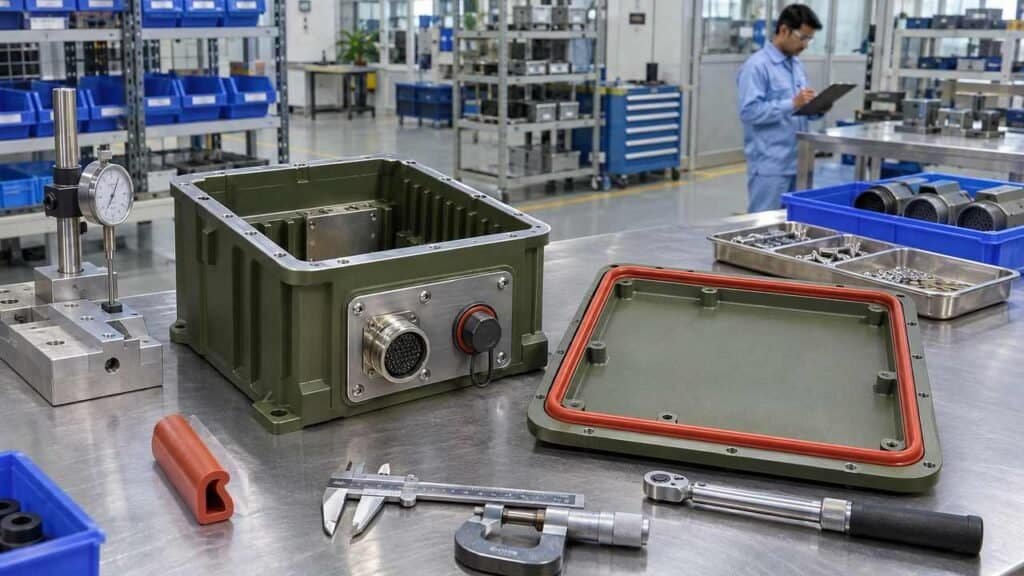
Silicone Extrusions help protect military avionics and electronic enclosures by sealing the gaps around access panels, equipment doors, cable interfaces, and enclosure frames. A correctly designed profile helps limit the entry of moisture, dust, salt-laden air, and other contaminants that can affect connectors, circuit assemblies, and sensitive electronic hardware.
The profile must suit the actual enclosure design. Rubber Extrusion solutions can be developed around the panel thickness, sealing gap, mounting channel, compression requirement, and service conditions of the equipment.
What avionics enclosures have to withstand
Avionics equipment can face conditions that are far more demanding than those of a standard industrial control cabinet. Temperature changes, altitude, humidity, vibration, shock, and repeated maintenance access all place pressure on the enclosure and its seals.
A small gap around an access cover can become a path for moisture or fine dust. Once contamination reaches connectors or wiring, corrosion and intermittent electrical faults become more likely. In a defence application, finding and correcting an intermittent issue can take far longer than replacing a visibly damaged component.
Environmental sealing therefore has a practical purpose: it helps the enclosure maintain a controlled internal environment around the electronics.
Where silicone extrusion profiles are used
Silicone extrusion profiles can be used at several points on avionics and defence-electronics equipment:
- Access-panel and inspection-door perimeters
- Electronic equipment cases and rack-mounted enclosures
- Communication-system housings
- Cable-entry covers and connector-interface areas
- Sensor and surveillance equipment enclosures
- Removable covers on ground-support and field-deployed electronics
Each interface has its own sealing requirement. A frequently opened access door may need a soft bulb profile that seals with moderate latch pressure. A fixed metal cover may need a U-channel profile that grips the panel edge while providing a sealing lip. A large fabricated enclosure may require a sponge section that can accommodate small variations in the gap.
A maintenance situation that shows why profile design matters
Consider an avionics enclosure that is opened during scheduled inspection. The metal cover is refitted after servicing, but its sealing surface has minor variation caused by vibration, repeated fastener tightening, and normal handling.
If the existing seal is too hard, the cover may not close evenly. If it is too thin, the corners may not maintain contact. In either case, the enclosure can lose its intended environmental protection even when it appears properly assembled.
A custom silicone profile can be designed to match the actual gap and closing force. The aim is to create reliable contact around the perimeter without making the cover difficult to remove during maintenance. This is especially important where technicians must access the equipment quickly and refit the cover correctly in the field.
For a related example of silicone profiles used around temperature-sensitive equipment interfaces, read High-Temperature Silicone Extrusions for Environmental Sealing in Aerospace Applications.
Selecting the right profile for the enclosure
The material alone does not determine whether a seal will work. Engineers should consider the profile shape, sealing gap, compression range, panel movement, and installation method.
A useful starting point is to review:
- The enclosure drawing and panel-edge thickness
- The gap around the full perimeter, including corners
- The number of times the cover will be removed and refitted
- Exposure to temperature changes, humidity, dust, vibration, and sunlight
- The fastening or latching force available
- Any nearby fluids, lubricants, fuel, or hydraulic systems
These details help determine whether the application needs a solid section, sponge profile, bulb seal, edge trim, or a co-extruded design with separate gripping and sealing sections.
Silicone must be matched to the operating environment
Silicone is widely used for high-temperature and environmental-sealing applications because it remains flexible across demanding conditions. However, material selection should be based on the full operating environment.
Standard silicone is generally not the right choice where the seal will have continuous contact with fuels, petroleum oils, or certain hydraulic fluids. In those cases, the equipment designer may need fluorosilicone or another compatible elastomer. Confirming fluid exposure before choosing the compound avoids installing a profile that is unsuitable for the location.
There is also a difference between environmental sealing and EMI shielding. A standard silicone extrusion can help seal against moisture and contamination, but it does not automatically provide electromagnetic shielding. Where EMI control is required, the enclosure design may need a conductive elastomer gasket or another dedicated shielding solution.
Supporting dependable enclosure protection
A well-designed silicone extrusion is a small component in a military electronic system, but it protects interfaces that are exposed every time a cover is opened, a connector is serviced, or equipment operates in a changing environment.
Shree Rubber Works supplies custom rubber solutions for industrial and specialised equipment applications. Share the enclosure drawing, sealing gap, panel details, and operating conditions before finalising the profile. For a specific silicone extrusion requirement, contact our team.