
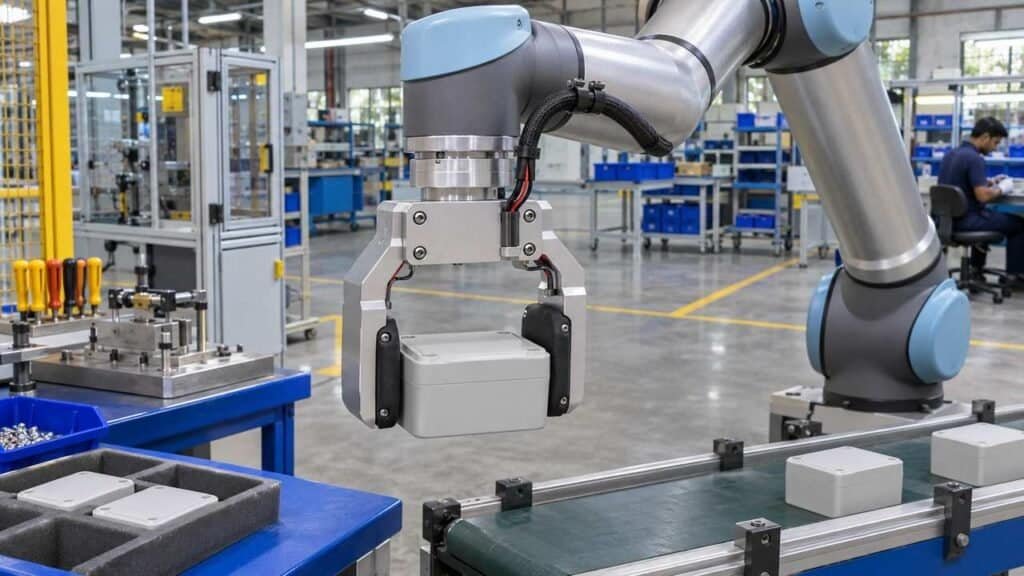
Smart Conductive Rubber can give a robot useful touch feedback by changing its electrical response when it is pressed, bent, stretched, or deformed. In robotic grippers, flexible contact pads, and tactile interfaces, this can help the system detect contact, monitor grip behaviour, and respond more carefully when handling objects or working close to people.
Vision systems can identify an object before a robot reaches it, but they cannot always confirm what is happening at the contact point. A robotic finger may touch a part without holding it securely. A gripper may begin to slip after lifting an item. Tactile feedback gives the control system another source of information during those moments.
Why feedback at the contact point matters
Robots handle many products that cannot be gripped with one fixed force. Fragile plastic housings, glass parts, flexible packaging, small electronic components, and uneven objects all respond differently when a gripper closes around them.
A flexible conductive elastomer can be shaped into a contact pad that deforms with the object. That deformation can create an electrical change for the sensing system to interpret. The robot can then use the signal to confirm that contact has occurred or to adjust how it grips the part.
Custom Rubber Moulding Products & Parts allow conductive pads, sensing layers, soft robot covers, and contact interfaces to be made around the actual shape of a gripper finger, end effector, handle, or robotic surface.
How Smart Conductive Rubber creates a tactile signal
Smart Conductive Rubber is formulated so that its electrical properties respond to physical deformation. Depending on the sensor design, the system may measure a change in resistance, impedance, or another electrical value as the component is compressed or bent.
The conductive rubber part is one element of the sensing system. Electrodes, wiring, electronics, and software are also required to collect and interpret the signal. The design of the molded part affects the quality of that signal. Thickness, hardness, conductive-compound formulation, surface pattern, and mounting support can all change how the component responds.
A thin pad may be suitable for light-contact detection. A thicker or structured component may be better where the robot needs more controlled compression or a broader contact surface.
From touch to robotic response
The sensing process follows the same sequence each time the robot makes contact with an object.
- Contact
The gripper pad, robot surface, or flexible interface touches an object or receives a human touch. - Material deformation
The Smart Conductive Rubber component compresses, bends, or stretches according to the contact force and surface shape. - Signal reading
The deformation changes the component’s electrical response. Electrodes and sensing electronics read that change. - Robot response
The control system uses the signal to confirm contact, adjust grip force, detect a possible slip, or trigger the next programmed movement.
The exact response depends on the component geometry, conductive compound, electrode placement, calibration, and control logic. This is why the rubber part should be designed as part of the complete tactile-sensing assembly.
A practical robotic-gripper example
Consider a collaborative robot that transfers smooth plastic electrical housings from a conveyor into an assembly fixture. The housings are lightweight, but they can be scratched or deformed if the gripper applies too much pressure.
Flexible conductive pads are fitted to the gripper fingers. As the fingers close around a housing, the pads compress and create a measurable electrical response. The controller uses that feedback to confirm contact and prevent unnecessary additional force.
If the housing shifts while being lifted, the contact pattern may change. The system can use that information as one input for adjusting the grip within its programmed limits. The rubber pad therefore provides both a soft contact surface and a source of tactile information.
For a related look at robot-contact components, read Custom Moulded Gripper Pads and End-Effector Components for Industrial Robots.
Repeatable sensing is more important than an impressive first test
A tactile component must give a useful response over repeated working cycles. Soft conductive materials can show hysteresis, where the signal during release differs from the signal produced while pressure is applied. The response can also drift because of temperature changes, repeated compression, mounting stress, or material ageing.
This does not prevent the use of conductive elastomers in robotics. It means the component should be tested for the real job it will perform. A pad used only to detect that an object has been touched may need less precision than a sensor used to control gripping force.
Calibration is important where force information affects robot motion. The sensor output should be compared against known loads so the control system has a reliable basis for interpreting the electrical signal.
Supporting human-machine interaction
Flexible tactile components can also be used on collaborative robots, assistive equipment, soft robotic systems, and responsive control interfaces. They may help the system detect a human touch or physical contact on a robot surface.
The component must be considered as part of the wider robot design. Smart Conductive Rubber does not independently make a robot safe for human contact. Robot speed, force limits, emergency functions, control logic, sensor validation, and the application itself all affect safety.
Details to define before developing a custom component
A robotics team should share the intended sensing function and the working environment before finalising the part. Useful details include:
- Contact area, part geometry, and mounting method
- Expected force range and cycle frequency
- Whether the component senses touch, grip, bending, or deformation
- Required hardness, flexibility, and surface texture
- Electrode and wire connection locations
- Exposure to dust, oil, moisture, cleaning, or heat
- Any antistatic, conductive, or electrical-response requirement
For custom rubber solutions for robotics and automation, visit Shree Rubber Works.
The completed component should be evaluated as part of the full sensor assembly, including its electrodes, wiring, and control response. For help with a Smart Conductive Rubber requirement, contact our team.