
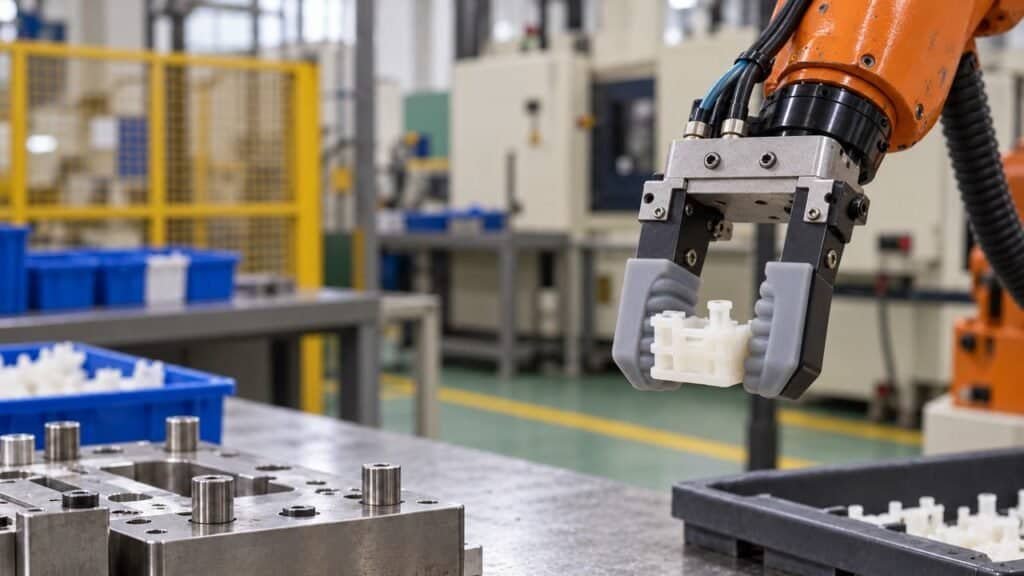
Robotics is moving beyond rigid grippers and fixed automation. In applications involving delicate, irregular, lightweight, or easily damaged parts, conventional hard tooling can apply too much force or struggle to adapt to changing shapes.
Soft robotics uses flexible materials and controlled deformation to handle these challenges. Precision silicone molded components can help create compliant grippers, soft actuator parts, protective pads, flexible interfaces, and end-effector elements that interact more safely with products, equipment, and people.
How does silicone moulding support soft robotics and flexible automation?
Silicone moulding supports soft robotics by producing flexible components with controlled shapes, repeatable dimensions, and application-specific material properties. These components can be used in soft gripper fingers, pneumatic actuator sections, cushioning pads, seals, and protective contact surfaces. Their flexibility allows robotic systems to conform more closely to an object instead of relying only on high gripping force.
For applications requiring a custom shape, material hardness, or controlled contact surface, custom silicone moulding components can be designed around the end-effector and the object being handled.
Why flexible components matter in robotics
A traditional robotic gripper is often designed for repeatable handling of a known part. It can work very well in a controlled environment, but it may be less suitable for fragile products, mixed product sizes, uneven surfaces, or human-facing automation.
Soft robotic components change the way the end effector interacts with an object. A compliant surface can distribute contact pressure across a larger area. A flexible finger can adapt around an irregular object. A molded silicone pad can help protect delicate surfaces while still providing controlled contact.
This is useful in applications such as:
- Food and bakery handling
- Pharmaceutical and laboratory automation
- Consumer-product assembly
- Electronics handling
- Packaging and sorting
- Collaborative robotic systems
The goal is not simply to make a robot “soft.” The goal is to make contact more controlled, repeatable, and suitable for the product being handled.
Common silicone molded components used in soft robotics
Precision silicone molded components can be developed for several parts of a robotic system.
Soft gripper fingers
Soft gripper fingers are designed to bend, compress, or conform around an object. Depending on the design, they may include smooth contact surfaces, internal cavities, attachment features, or reinforced sections.
Pneumatic actuator components
Many soft robotic systems use air pressure to create movement. A molded silicone component can include shaped channels, chambers, or flexible walls that deform when pressurised. The geometry of these features affects how the component bends, expands, or grips.
Gripper pads and contact surfaces
Silicone pads can be fitted to rigid robotic fingers to create a softer contact point. This approach can help reduce marking, slipping, or excessive local pressure when handling sensitive parts.
Protective covers and flexible interfaces
Silicone moulding can also be used for cable protection, sensor covers, flexible mounts, and enclosure interfaces. These parts may not perform the gripping function directly, but they support the durability and reliability of the robotic system.
Precision matters in soft robotic components
Soft components are flexible, but their dimensions still need to be controlled. A small change in wall thickness, cavity depth, or contact geometry can affect how a soft actuator moves or how a gripper contacts an object.
For example, a pneumatic gripper finger may bend differently if one wall is thicker than intended. A gripping pad may produce inconsistent results if the surface profile changes from part to part. A molded component with a poorly designed attachment point may tear or move during repeated cycles.
The design process should therefore consider:
- Required flexibility and hardness
- Component thickness and wall consistency
- Load and movement direction
- Repeated compression or bending cycles
- Attachment to the robot end effector
- Surface finish required for product contact
- Environmental exposure, including cleaning processes or temperature
A molded component should be designed around the motion and task it needs to perform, not only around its overall appearance.
A practical soft-gripper example
Consider a robot that needs to pick delicate plastic containers from a conveyor. The containers vary slightly in shape, and applying too much force could deform them.
Instead of using a rigid jaw with a high clamping force, the end effector can use molded silicone gripper pads or flexible fingers. When the gripper closes, the silicone surface conforms to the container and spreads the contact load across a wider area. This can improve handling stability while reducing the risk of visible marks or damage.
In more advanced soft-gripper designs, molded silicone sections can contain internal pneumatic chambers. When air is introduced, the component bends around the object. The result depends on the chamber design, wall thickness, reinforcement, air pressure, and material properties.
For related applications in end effectors and industrial robotics, see custom moulded components for industrial robots.
Selecting the right silicone moulding design
Before developing a component, it is important to define the actual operating requirement.
Define the handling task
What is the robot picking, holding, positioning, or protecting? The object’s size, surface, weight, fragility, and variation all influence the component design.
Choose the right contact behaviour
Some applications require a soft, high-conformability surface. Others need greater shape stability or resistance to repeated compression. The material hardness and geometry should match the required grip and movement.
Review the mounting arrangement
A good molded component must attach securely to the robotic system. Consider fasteners, bonding surfaces, slots, inserts, or mechanical retention features during the design stage.
Plan for repeatability
Robotics depends on consistent movement. The component should be evaluated for its expected cycle frequency, compression pattern, deformation range, and maintenance needs.
Frequently asked questions
What are silicone molded components used for in soft robotics?
They are used for flexible gripper fingers, contact pads, pneumatic actuator sections, protective covers, sensor interfaces, and other compliant parts that help robots interact safely with objects.
Can silicone moulding be customised for a robotic end effector?
Yes. Components can be customised by shape, size, hardness, surface profile, attachment feature, and functional geometry according to the robotic application.
Are soft silicone components suitable for delicate-product handling?
They can be suitable when the material, shape, and gripping force are selected for the product. The final design should be tested with the actual item and operating cycle.
Building more adaptable robotic systems
Precision silicone molded components help robotics engineers create end effectors that are more adaptable, gentler, and better suited to variable handling tasks. The best solution begins with a clear understanding of the object, movement, contact force, cycle requirement, and mounting method.
For custom rubber and silicone components for flexible automation, contact Shree Rubber Works.