
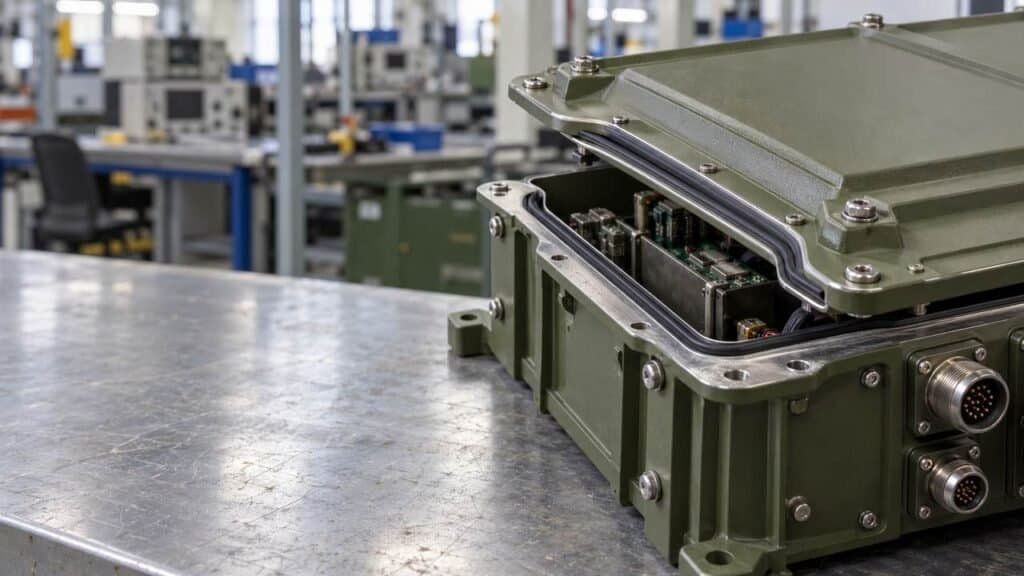
Military electronics operate in environments where communications, sensing, navigation, and control systems must remain dependable despite vibration, moisture, dust, temperature changes, and electromagnetic interference. A small gap in an enclosure can become a pathway for unwanted electromagnetic energy and can also allow environmental contamination to enter.
Smart conductive rubber helps address both issues at the same interface. It can provide a compressible environmental seal while creating an electrical path between mating enclosure surfaces for EMI shielding.
How does smart conductive rubber support EMI shielding in defense electronics?
Smart conductive rubber is an elastomer formulated with conductive fillers so that it can carry electrical continuity across an enclosure joint. When compressed between properly designed mating surfaces, it helps close the physical gap and supports EMI shielding around electronic housings, communication units, access covers, and connector interfaces.
This makes conductive elastomers useful where a rigid metal-to-metal joint alone is not practical because the enclosure also needs flexibility, repeatable compression, vibration tolerance, or environmental sealing.
For custom-shaped shielding gaskets and enclosure components, see conductive rubber moulded components for EMI shielding.
The real weakness is often the enclosure joint
Military systems may have a metal housing, shielded cable, and carefully designed electronics, but shielding performance can still be affected by openings, joints, seams, removable covers, and connector cut-outs.
These areas need more than a basic rubber gasket. A standard non-conductive seal may keep out dust or water, but it does not create the electrical continuity required for an EMI-shielded enclosure. A conductive gasket is designed to bridge the interface between mating conductive surfaces while also conforming to minor surface irregularities.
The final performance depends on the complete joint design:
- Enclosure material and surface treatment
- Gasket geometry and compression range
- Contact pressure across the full sealing path
- Bolt spacing and flange flatness
- Environmental exposure
- Required frequency range and shielding performance
A conductive elastomer is therefore one part of the shielding system, not a substitute for proper enclosure design or grounding.
Where conductive elastomers can be used
Smart conductive rubber can be considered for several defense-electronics applications:
Communication and radio enclosures
Portable, vehicle-mounted, and fixed communication systems may require shields around electronic housings, panels, and access covers. A conductive gasket can help maintain continuity across removable joints while allowing the unit to be serviced.
Radar, sensor, and surveillance equipment
Sensor housings often face vibration, outdoor exposure, and frequent maintenance. Conductive elastomer seals can be designed for cover joints and enclosure interfaces where EMI protection and environmental sealing are both required.
Ruggedized command-and-control systems
Field-deployed electronics may need protection from dust, moisture, and electromagnetic interference at panel doors, display housings, cable entries, and equipment cabinets.
Connector and cable-interface areas
Cable-entry points can become weak points in an enclosure. The interface needs careful mechanical and electrical design so that the shielding path is not interrupted around the opening.
For related ruggedized electronics applications, see ruggedized sealing solutions for defense electronics.
What engineers should define before selecting a conductive gasket
A good technical brief helps avoid choosing a material based only on the phrase “conductive rubber.”
Before selecting or developing a molded component, define:
- The enclosure joint
Share drawings, flange dimensions, fastener locations, mating-surface material, and available gasket space. - The environmental conditions
Identify expected temperature range, humidity, salt-fog exposure, dust, vibration, fuel or chemical exposure, and outdoor service conditions. - The required shielding performance
The frequency range, test method, and specification should be defined by the system requirement. Do not assume that all conductive compounds provide the same shielding level. - The compression range
Conductivity and sealing depend on the gasket being compressed correctly. Too little compression may reduce electrical contact. Too much may damage the part, distort the enclosure, or shorten service life. - The maintenance requirement
If the cover is regularly removed, the gasket must be designed for repeated opening and closing without tearing, shifting, or losing its intended contact path.
Conductive molded parts versus conductive sealing profiles
Conductive molded components are useful when the enclosure has corners, complex shapes, cut-outs, mounting features, or application-specific geometry. They can be designed around a cover, connector, or electronic assembly.
Conductive profiles are often useful for long, continuous joints such as cabinet doors, panel perimeters, and enclosure edges. The choice depends on whether the part requires a continuous length, a complex three-dimensional shape, or a combination of both.
In some cases, a design may use molded corner pieces together with a continuous conductive profile. The best approach should be based on the actual enclosure interface and assembly process.
Common EMI-shielding mistakes to avoid
- Selecting a gasket without confirming its shielding requirement
- Using a conductive gasket against unsuitable or non-conductive mating surfaces
- Ignoring surface corrosion, coatings, or contamination at the interface
- Designing uneven compression around a cover or door
- Treating a conductive seal as the only shielding measure in a system
- Choosing a standard profile without checking enclosure tolerances and service conditions
Environmental exposure can affect both the elastomer and the mating surface. For defense applications, shielding performance should be verified using the relevant test requirement after considering the actual operating environment.
Frequently asked questions
What is smart conductive rubber?
Smart conductive rubber is an elastomeric material formulated with conductive fillers. It can be used in components that need flexibility and compression while also providing an electrical path for EMI shielding.
Can conductive rubber also provide environmental sealing?
Yes. A conductive elastomer can be designed to help seal against dust, moisture, and other environmental exposure while supporting electrical continuity across an enclosure joint. The final performance depends on the compound, gasket design, and mating surfaces.
Is a conductive gasket suitable for every military enclosure?
No. The material, profile, compression, surface finish, and required shielding performance must be reviewed for the specific enclosure and application.
Build shielding into the enclosure interface
For military electronics and communication systems, the enclosure joint should be treated as part of the EMI-shielding strategy. Smart conductive rubber can provide a practical combination of electrical continuity and environmental sealing when it is selected around the actual operating conditions and joint design.
For custom rubber components for defense electronics and communication systems, contact Shree Rubber Works.