
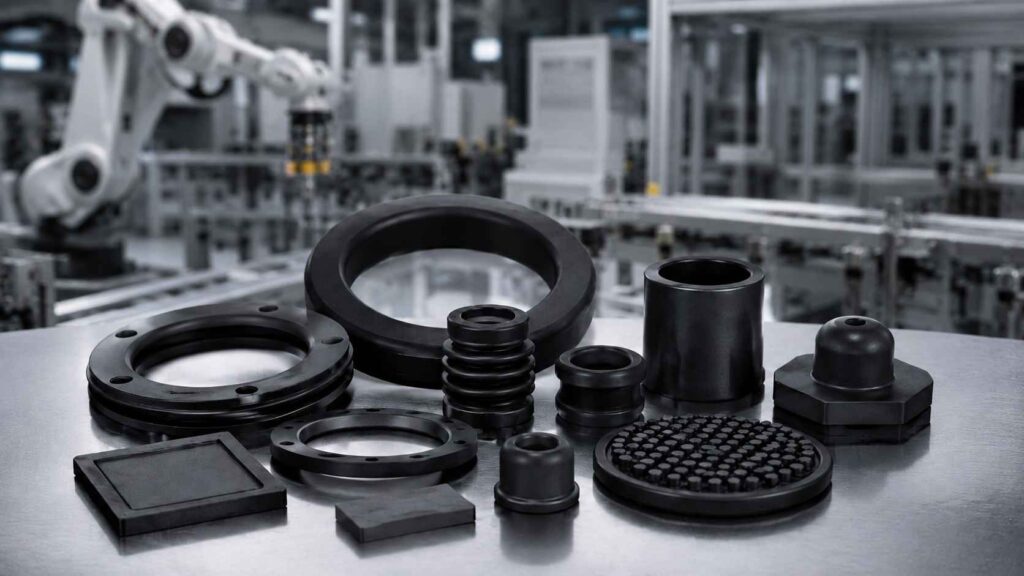
Smart conductive rubber components help equipment detect pressure, strain, vibration, or movement changes in real time. They support predictive maintenance by turning rubber parts into functional sensing elements.
Industrial equipment is becoming more connected, more automated, and more data-driven. Machines are no longer expected to only perform; they are also expected to communicate early signs of wear, stress, overload, or failure. This shift has created growing interest in smart materials that can support real-time equipment monitoring.
Conductive rubber components are one such solution. Unlike conventional rubber parts that mainly provide sealing, cushioning, or protection, conductive rubber can also respond to mechanical changes. When designed with conductive fillers, the rubber can show changes in electrical behavior under pressure, strain, or movement. This makes it useful for smart industrial components, sensing applications, and condition monitoring systems.
Rubber That Does More Than Protect
Traditional rubber components are used in machines because they are flexible, durable, and capable of absorbing movement. Conductive rubber adds another layer of functionality. It can be engineered to carry electrical signals or respond to changes in compression, stretching, or vibration.
This is valuable in equipment where early detection matters. Instead of waiting for a gasket, pad, seal, mount, or contact part to fail, smart conductive rubber components can support monitoring systems that track changes while the equipment is still running.
Industrial condition monitoring often uses sensors to identify early signs of machine issues, reduce downtime, and improve maintenance planning. Sensors for vibration, pressure, temperature, speed, and position are already important in predictive maintenance environments.
How Conductive Rubber Supports Monitoring
Conductive rubber components are usually made by combining elastomers with conductive materials such as carbon-based fillers. These fillers allow the rubber to conduct electricity or respond electrically when the material is compressed, stretched, or deformed.
In simple terms, the component can act as both a rubber part and a sensing interface. When pressure or movement changes, the electrical response can also change. This makes conductive rubber useful in applications where mechanical behavior needs to be tracked.
Where These Components Can Be Used
Smart conductive rubber components can be useful in equipment areas where contact, movement, vibration, or pressure needs to be observed. These may include machine mounts, sealing systems, flexible pads, robotic grippers, safety edges, pressure-sensitive surfaces, vibration-dampening parts, and custom molded rubber components.
For example, a conductive rubber pad may help detect pressure variation. A conductive gasket may support contact monitoring. A molded conductive part may be designed for equipment zones where deformation needs to be tracked. In automated and heavy-duty industrial systems, such information can help maintenance teams understand equipment behavior more clearly.
A Better Fit for Predictive Maintenance
Predictive maintenance depends on identifying changes before they become failures. Smart conductive rubber components can contribute to this approach by helping monitor stress, movement, or pressure in critical areas.
This does not mean every rubber component needs to become a sensor. The value comes from using conductive rubber in the right places, especially where mechanical changes are directly connected to equipment performance. When used correctly, these components can help reduce unplanned downtime, improve maintenance decisions, and support better equipment reliability.
Designed for Harsh Industrial Use
Industrial monitoring components must survive the same environment as the machine itself. They may face vibration, heat, dust, oils, chemicals, moisture, compression, and repeated movement. This is why material selection is important.
Conductive rubber components can be customized based on the equipment requirement. The elastomer type, hardness, shape, conductivity level, and mechanical properties can be adjusted depending on the application. This makes them suitable for custom industrial solutions where both rubber performance and signal response are required.
Customization Matters
No two monitoring applications are exactly the same. A rubber component used near a robotic gripper will not have the same requirement as a conductive seal used in industrial equipment. The design must match the load, movement, contact area, electrical response, and operating environment.
Smart conductive rubber components can be developed in different forms such as molded pads, gaskets, strips, seals, profiles, contact parts, and custom-shaped components. The final design depends on how the part needs to behave mechanically and how it needs to support monitoring.
Conclusion
Smart conductive rubber components bring together the flexibility of rubber and the functionality of sensing materials. They can support real-time equipment monitoring by helping detect pressure, strain, vibration, movement, or contact changes in industrial systems.
At Shree Rubber Works, we manufacture customized rubber components for demanding industrial applications. Our conductive rubber components can be developed as per specific size, shape, hardness, material, and performance requirements to support real-time monitoring, equipment protection, and smart industrial applications. Contact us today to discuss your custom conductive rubber component requirements.